Some apparatus makes things visible by selecting: an object is illuminated, a voice amplified, an image framed. Other apparatus remains in the background, determining what can be perceived at all. In Appenzell, two exhibitions opening in parallel explore these conditions of seeing and hearing – from very different perspectives.
From 15 November, the Kunstmuseum presents Florian Germann’s «Zwölf Leben», while the Kunsthalle presents Gabriela Löffel’s «Grammatik der Lücken» in parallel. Both venues give 11 April 2027 as the closing date. Their proximity alone invites comparison: Germann conceives of sculpture as an open system, while Löffel traces how images, language and technical infrastructures mediate reality. This is a productive connection, but not a claim that the two artists advance the same proposition.
Sculptures as open systems
Germann’s works can be sculptures, models or experimental set-ups. The Kunstmuseum describes them as meeting places for people, animals, technology and the environment; some are actually used by plants, insects or birds. This shifts the question of what constitutes the work: it is not merely a form to be viewed, but can also be a habitat and respond to its surroundings.
The exhibition is intended to bring together different forms of work and incorporate the museum itself, including the transition between interior and exterior space. Specific details of the arrangement have not been published in advance. Any description of the forthcoming spaces would therefore be speculative. What is certain is that Germann’s approach focuses attention on energy and interaction – on what circulates between materials, living beings and artificial systems. Here, an apparatus need not look like a device. It can organise a relationship.
What images and voices leave out
Löffel’s work begins with the processes through which reality is narrated and ordered. According to the Kunsthalle, her video works emerge from extended research in places such as military training grounds, financial events and courtrooms. In her installations, she combines image, sound, language and spatial staging. What matters is not only what can be seen, but also: who is speaking? What remains inaudible? And what creates the impression that a representation is complete?
The exhibition brings together works from different years. «Setting» (2011) addresses the staging of war and its audiovisual mediation, drawing, among other sources, on accounts by former extras at a US military training ground in Grafenwöhr. «Grammar of Calculated Ambiguity» (2024) takes unintelligible passages in an audio recording of an offshore finance conference as its starting point: specialists reconstruct them in a recording studio. In both cases, mediation itself becomes the subject – the voice is not simply evidence, nor is the image a neutral window.
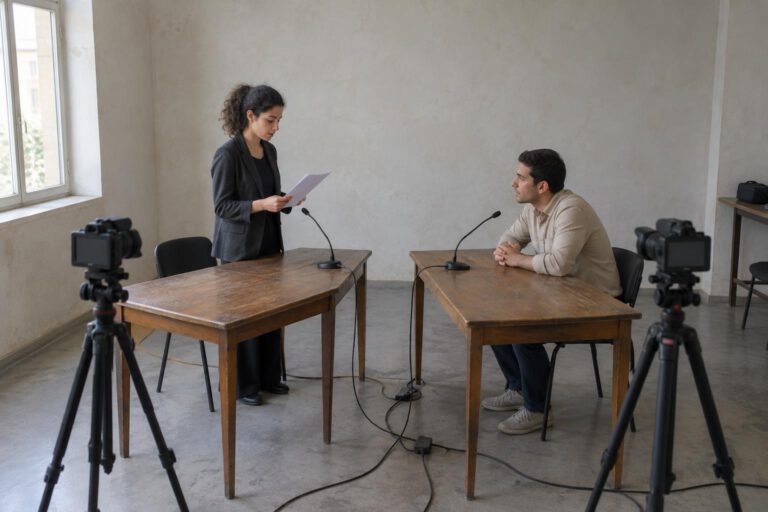
Löffel’s new multichannel video installation «for the record» (2026) addresses the collapse of the Lebanese banking system and possible connections to the Swiss financial sector. It uses archival material and a fictional court hearing staged with law students in Beirut. This construction does not turn the case into a mere illustration: it reveals how law, research and cinematic representation investigate a reality while also shaping it.
Two scales of perception
Germann and Löffel place different emphases. In Germann’s work, attention turns to relationships between bodies, materials and environments; in Löffel’s, to the rules and infrastructures that make images and statements legible. In both cases, perception can be understood as something that does not simply happen, but depends on certain conditions. Yet while Germann’s works, according to the museum, are intended to enable encounters and processes, Löffel’s practice examines the political and economic interests that determine the distribution of visibility.
Alongside this, Löffel is curating a video programme for the «Imagining Kunsthalle» series, featuring works by Basma al-Sharif, Marwa Arsanios, Haig Aivazian, Border Forensics, Miranda Pennell and Mohamed Choucair. Among its subjects are the remembrance of political events and the role of archives, testimony and forensic images. This broadens the focus from the individual installation to collective forms of showing and bearing witness.
The strength of the comparison lies in not reducing the works to a shared formula. A sculpture conceived as a habitat is not the same as a video work that reconstructs power relations. Together, however, the exhibitions can bring one question into sharper focus: what apparatus – visible and invisible – mediates our perception, and who can change it? That will only become clear in the actual spaces.
Original reviewed by the editors · 1 November 2026