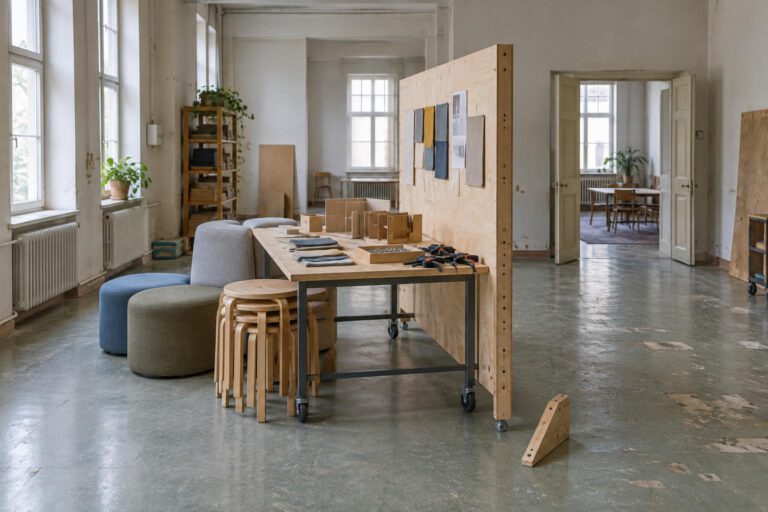
After the art festival, the question of the future returns: who keeps a church open once the exhibition has been dismantled? In Bochum, this question takes concrete shape at Christ König. The church on Steinring was a venue for Manifesta 16 Ruhr; now students from TU Dortmund University are presenting designs there for new uses of sacred spaces. According to the university, the exhibition “Kirche weiterbauen – Kulturhaus Ruhr” (Reworking Churches – Ruhr Cultural Centre) is scheduled to run from 7 November to 13 December 2026. A conflicting date listing on BauNetz makes the university’s information the authoritative confirmation.
For now, the projects are proposals, not approved building schemes. For five churches in Essen, Bochum and Wattenscheid, 30 graduates developed ideas ranging from studios and movement spaces to stages, libraries and places for digital work. As the Chair of Solid Building Construction describes it, the brief asks how a new use can be integrated into an existing space without simply erasing its distinctive atmosphere.
From Art Venue to Everyday Use
Christ König was built in 1932. During Ruhr’s year as European Capital of Culture in 2010, the church became the art church of the Diocese of Essen. According to Bochum’s cultural development report, the initially temporary project ran for ten years and encompassed around 40 art projects; the art church closed in 2019. In 2026, Manifesta 16 Ruhr once again brought contemporary art into the building. Such episodes show that a church can be brought to life through culture. But they do not answer the question of who opens, manages, heats and maintains it on a day-to-day basis.
This is precisely where the difference lies between a good idea and a cultural venue. A design can show how a nave might be divided or supplemented with additional rooms. Yet it cannot, on its own, establish who retains ownership, who funds the investment and which organisation will pay for staff, programming and building operations in the long term. Feasibility also involves fire safety, accessibility, energy supply and the question of which interventions are compatible with the building’s condition and any heritage protection. The sources reviewed provide no reliable figures for the specific costs of this work at Christ König.
Governance Is Part of the Design
A comparison within Bochum shows why the operating model and architecture need to be considered together: the former Friedenskirche has been run as the Q1 neighbourhood centre since 2015. According to the cultural development report, the project was established under the joint management of the Protestant parish and the association IFAK; among other facilities, it brings together spaces for groups, young people and events. This is no universally applicable formula. It does, however, demonstrate that repurposing a building is not accomplished through a single cultural event, but requires an organisation and activities that serve everyday life.
For Christ König, there is a more concrete, though still unresolved, proposal: the planned production centre “Puck – Puppenspiel in Christ-König” (Puck – Puppetry at Christ-König). A city council document describes two performance venues alongside work, rehearsal and residency spaces. The feasibility study summarised there estimates that implementation would require investment in the tens of millions. That indicates a scale, not a funding commitment. In June 2026, the WAZ reported that the city had put the plans on hold for the time being because of the high construction costs; no definitive current decision could be verified from the primary sources reviewed.
Establishing Need Before Promising a Programme
Nor can the question of local need be answered by counting design ideas. Establishing which activities are missing, who would use them regularly and whether operations would be viable outside major festivals requires discussions with neighbours, cultural practitioners and potential operators. The sources reviewed provide no current demand or operational data of this kind for Christ König. This gap is particularly important: a cultural centre that addresses its surroundings solely as an audience is different from a place where local initiatives help shape spaces and share responsibility.
The exhibition therefore provides a useful test, not a final answer. Reworking churches means taking existing fabric and its spatial character seriously — while also considering operations, access and responsibility. After the festival, the future will not be decided solely by what might happen in a nave. What matters is who takes the keys and assumes responsibility for the everyday work behind them.
Original reviewed by the editors · 4 November 2026