An orchestra is more than a collection of instruments. It embodies inherited ideals of sound, well-rehearsed routines and a familiar relationship between music desk, conductor and score. What happens when composers do not abolish this order, but shift it from within? Two world premieres at musica viva in Munich offer different answers: Michael Reudenbach’s ‘fast dasselbe’ (almost the same) and Clara Iannotta’s ‘sand like gold-leaf in smithereens’.
On Friday, 30 October, the Bavarian Radio Symphony Orchestra and violinist Carolin Widmann perform in the Herkulessaal at the Residenz. Franck Ollu conducts. Alongside the two new works, the programme includes Hans Zender’s ‘33 Veränderungen über 33 Veränderungen’ (33 Variations on 33 Variations) — a compositional engagement with Beethoven’s ‘Diabelli Variations’. The evening thus traces an arc from the present back to an older idea of musical transmission.
The familiar is already there
Reudenbach’s work is entitled ‘fast dasselbe’. His music for orchestra was commissioned by musica viva; the score was written in 2026. In the programme notes, the composer describes the orchestra itself as a historically shaped, firmly structured organism. For him, the question of how to relate to this tradition also concerns his own material: for the new piece, he deliberately returned to ideas from earlier scores, whether completed, unfinished or withdrawn.
This is more than a glance into the sketchbook. When musical figures recur in similar contexts and change in the process, the familiar becomes a touchstone: what do we recognise, and at what point has it already become something else? Reudenbach’s title suggests just such a shift. How it unfolds in sound and over the course of the piece cannot responsibly be anticipated before the world premiere.
A violin under new conditions
Iannotta’s ‘sand like gold-leaf in smithereens’ is a concerto for violin, orchestra and electronics, written for Carolin Widmann. BR promises unfamiliar registers and thicker strings that sound an octave lower. In the programme notes, Iannotta says these strings changed not only the sound, but time itself.
This also shifts the role of the solo instrument. The violin need not hold its own solely as a radiant voice in front of the orchestra: its timbre and register are specifically altered, while electronic sounds are added. The listed performers include Zoro Babel as sound director. This makes technical collaboration part of the performance — and raises practical questions: how are acoustic and electronic sound balanced against one another? How does the violin remain audible within the ensemble without reducing the orchestra to mere accompaniment? The answers depend on the score, the technology and the collaborative work; the concert is their first public test.
Not just playing, but coordinating
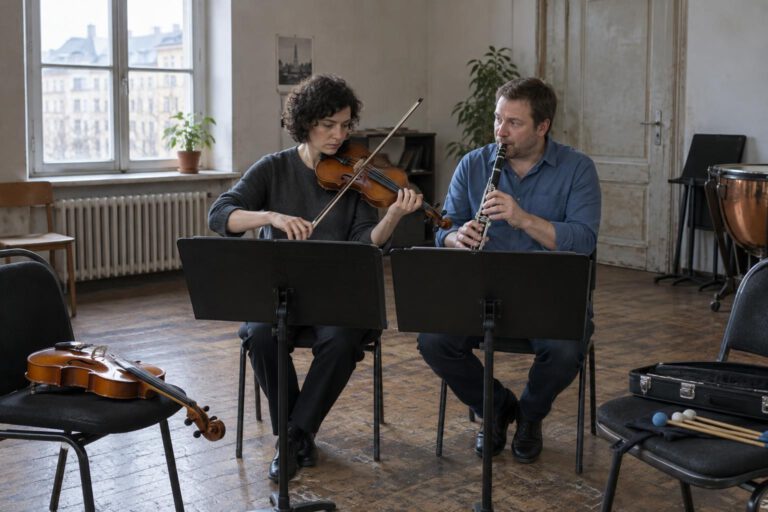
New orchestral music does not automatically call for different instruments. But it can change what musicians need to listen for as they play: barely perceptible differences, particular timbres, altered playing techniques or the balance with electronically generated sound. Playing the notes correctly is not enough. Conductor, ensemble and sound director must communicate precisely with one another; at the same time, a score has to be worked through in practice within limited rehearsal time.
How much additional coordination the two world premieres will actually require remains an open question before the concert. What is certain is that they pose different challenges. Reudenbach focuses on memory and continuation within orchestral music; Iannotta couples the traditional solo concerto with altered instrumental sounds and electronics. Hearing both in the same programme makes the evening an occasion not only to anticipate new works, but also to pay attention to how the orchestra works.
Bayerischer Rundfunk’s musica viva concert begins at 8pm on 30 October; a pre-concert talk is scheduled for 6.45pm. Alongside the two world premieres, Zender’s Beethoven arrangement provides a historical sounding board. The question of the new is thus posed not as a break with tradition, but as a process of working with what an orchestra already brings to it.
Original reviewed by the editors · 26 October 2026