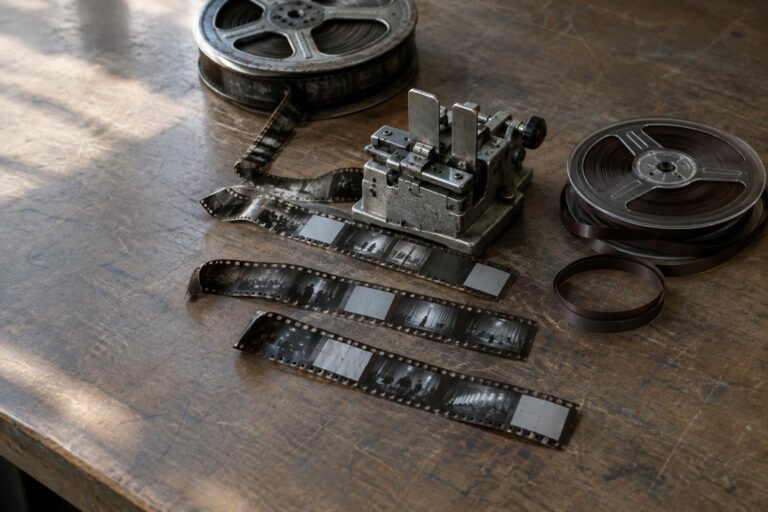
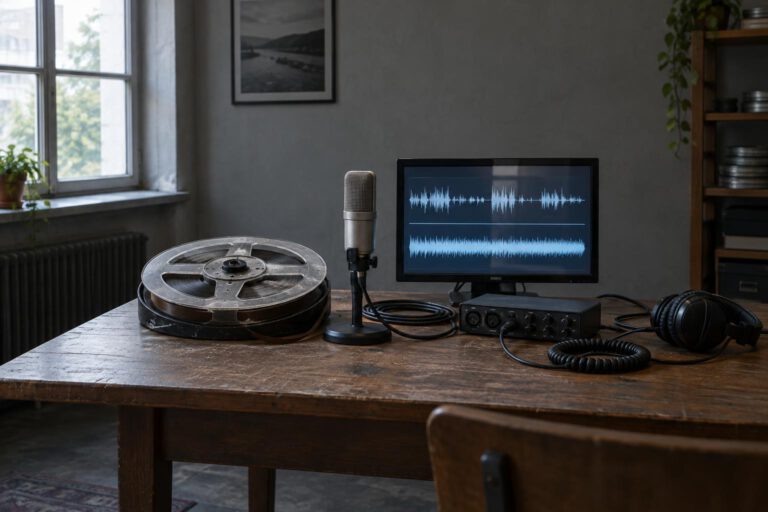
Theatre does not vanish without a trace. It leaves behind photographs, designs, reviews, diaries and – since technology made them possible – recordings of rehearsals and performances. Yet none of these traces is theatre itself. A photograph captures a gesture, but not its unfolding over time; a recording preserves voices and movements, but not the shared presence of performers and audience. An archival film cannot close this gap. Its real work lies elsewhere: it reveals how memory emerges from material and selection.
On 5 November, Sandra Prechtel’s documentary “Einar Schleef – Ich habe kein Deutschland gefunden” (Einar Schleef – I Found No Germany) opens in cinemas across Germany. There are two reasons for the occasion: Schleef died on 21 July 2001, making this year the 25th anniversary of his death. And his estate offers an unusually wide range of approaches to an artist who brought together theatre, literature, painting and photography. According to the distributor, the film works exclusively with archival material. That in itself is an editorial choice: Schleef appears not as the subject of retrospective interviews, but through images and sounds handed down from his life and work.
The event and its remains
A performance is an ephemeral art form, but not necessarily an undocumented one. Designs and photographs in the estate can show how Schleef thought and worked; diaries record self-observation and contemporary history. The Freie Universität Berlin describes his writings as complex notebooks with several layers of text: Schleef later transcribed early diary entries into digital files, sometimes supplementing them from memory. Even the written testimony, then, is not simply a window onto an unchanged moment. It has been revised, annotated and rearranged in retrospect.
This is all the more true of the stage. A recording may show how bodies move through space, how voices and the chorus are organised. But it does not convey how long a look lasted, what happened outside the frame or how an auditorium responded to a scene. Even a supposedly neutral document is framed: by camera position, technology and the process of preservation. What was not recorded does not simply remain invisible – it may be irretrievably lost.
Editing is a form of interpretation
An archival film gives scattered material an order. Which recording opens the portrait? Which voice is given space? What is juxtaposed, what is left out? Editing creates relationships that do not exist ready-made in the archive. It can leave contradictions unresolved, but it can also condense a biography into a coherent narrative. In Prechtel’s film, Schleef’s own voice becomes an important way in. This allows for intimacy without having new interviews explain the artist from a present-day perspective. At the same time, it increases the risk that his account of himself will overshadow other perspectives: those of collaborators, institutions and people who experienced his work.
This is not an objection to the film, but a necessary question to ask of any portrait drawn from an estate. Admiration can protect an artist from appropriation; it can also smooth away the challenging aspects of their work. Schleef’s theatre was shaped by collective forms and the use of large choruses. An archive that primarily brings together individual images and the director’s voice cannot automatically bridge that difference. The theatre-making was collaborative, even if it remains associated with a single person’s name.
Preservation does not mean repetition
The obvious counterargument is that a film about recorded theatre brings the event back, at least in part. It can indeed make material accessible again and establish connections that individual documents cannot convey. But repetition is not a return. A recording replaces neither the spatial situation nor the uncertainty felt at the time about what would happen next. This is precisely where the archive’s strength lies: not in passing off the past as the present, but in keeping its traces legible.
Schleef’s estate is preserved at the Akademie der Künste; his visual art estate has a history of its own and is held partly in Halle. This dispersal is a reminder that an oeuvre is not always preserved in one place and in a single form. An archival film can connect such holdings for an audience. It should not, however, be mistaken for a complete memory of theatre, but understood as a proposal for thinking with the traces that remain.
What an archival film can preserve of theatre, then, is not the performance as a whole. It preserves testimonies, voices, working methods and fragments – while also making palpable the absence that accompanies every document. This is not a weakness of film. It is the condition under which a stage from the past can become present at all: not as repetition, but as a question.
Original reviewed by the editors · 28 October 2026