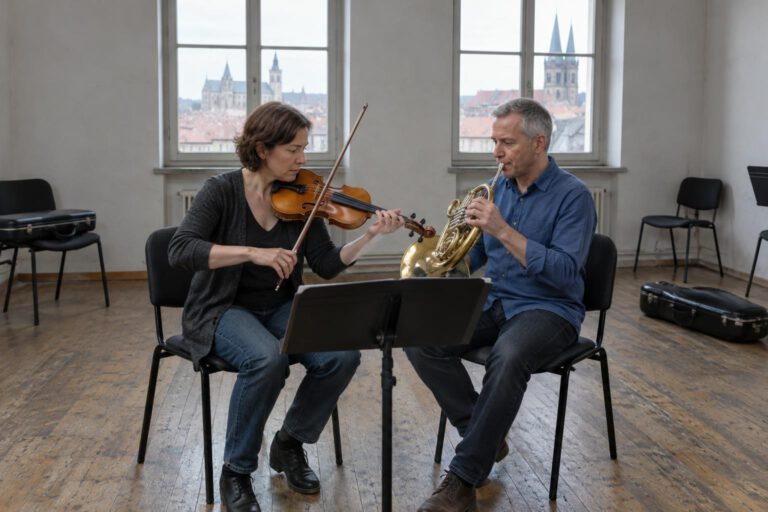
A dispute over seating arrangements initially sounds like something that could be resolved with enough chairs. For Iván Fischer and the Berlin Philharmonic, disagreement over the layout for Gustav Mahler’s Fifth Symphony led to a change of conductor. This could be told as a curious tale from the music business. What interests me more is the conception of art behind our possible bemusement: surely the music is the same, regardless of where anyone sits.
In the articles in our Culture Week, we repeatedly encounter this separation between what is supposedly essential and what is allegedly superficial. Content on one side, its arrangement on the other. The work on one side, the conditions under which it is perceived on the other. I find this distinction convenient and often wrong. Form is not packaging that must be removed before we can finally reach the meaning. It helps determine what meaning can emerge at all.
What the arrangement changes
Our article “Wer sitzt wo – und wer entscheidet darüber?” (Who Sits Where – and Who Decides?) therefore goes beyond the question of which party should have been more accommodating. Anyone who hastily reduces this conflict to vanity spares themselves the trouble of engaging with the issue itself. This neither vindicates Fischer nor puts the orchestra in the wrong. It simply acknowledges that a spatial decision can be a musical one. Whether it is convincing would then have to be argued on musical grounds – not on the basis of the standing of the person demanding it.
At first glance, it is a long way from the concert platform to the infographic. Our essay “Gestaltete Gewissheit: Warum Informationen nie nur Inhalt sind” (Designed Certainty: Why Information Is Never Just Content) suggests a connection. The Frankfurt exhibition “On Display. Wie Grafikdesign uns gestaltet” (On Display. How Graphic Design Shapes Us) examines how design influences our understanding of information. A graphic directs attention through size, proportion, emphasis and omission. Anyone who checks only whether the figures shown are correct has therefore not checked everything. Even an accurate figure can convey more certainty in a visual presentation than it warrants.
Eileen Gray offers another, very tangible approach. Her integrated thinking about furniture and architecture, explored in our profile accompanying the Kaiserslautern exhibition, challenges the idea of a finished space that merely needs furnishing afterwards. Living is not an afterthought to be addressed by a decorating brief. For me, this poses a productive challenge: a design must also be judged by the kind of life it enables, not solely by how coherent its concept appears.
No carte blanche for detail
The strongest objection to this argument is justified: claiming that every detail is essential can be used to block any change. Artistic precision then becomes a convenient right of veto. An institution needs procedures, a production needs limits, and collaboration needs compromise. Not every special request is convincing simply because it is put forward with aesthetic earnestness.
That is precisely why we should make finer distinctions. The question is not whether form matters, but what a particular form achieves. What does it change in our perception? What is lost through a compromise? And who has to bear the consequences of a decision? Such questions do not diminish art. They take its ambitions seriously enough to ask for a justification.
Cultural journalism should follow the same principle. We fail a work if we merely extract its message and dismiss the rest as furnishing. We fail it just as much if every formal assertion is enough to convince us of its quality. Between these comfortable positions lies the real work: describing how something is made and examining why it matters. Sometimes it really does begin with a chair.
Original reviewed by the editors · 4 November 2026