Ewald Palmetshofer writes for a world in which the old answers no longer hold. His characters talk, argue, justify themselves – all the while searching for a foundation that reaches beyond the present moment. This might be a faith, a political order, a family or simply the hope of not being left alone. On 2 November 2026, the playwright, born in Linz in 1978, received the Ludwig-Mülheims-Theaterpreis. The award honours work in which religious questions emerge not as a return to ready-made certainties, but as an open, often uncomfortable presence in contemporary life.
Palmetshofer studied theology in Vienna, alongside philosophy and psychology as part of a teacher-training course. His path through life does not automatically explain the plays, but it does help us understand why questions of guilt, meaning and responsibility recur so persistently in them. The prize awarded by the Archdiocese of Cologne highlights precisely this connection between theatre and religion. Yet Palmetshofer is not a writer who turns his characters into mouthpieces for a doctrine. Rather, he lets them speak from a position in which every answer is already shot through with doubts, interests and social dependencies.
Language as action
His play titles signal a distinctive style of writing: “hamlet ist tot. keine schwerkraft” (hamlet is dead. no gravity), “faust hat hunger und verschluckt sich an einer grete” (faust is hungry and chokes on a grete), “die unverheiratete” (the unmarried woman). The lower case and full stops are more than typographical quirks. They bring concepts into collision, leave thoughts suspended and deny the sentence an easy conclusion. Language is not merely a vehicle for the action; it becomes the very place where characters struggle for recognition and interpretation.
In an account of his own practice, Palmetshofer described his work as closely bound to speech and to the bodies of the actors. This is in keeping with a form of playwriting that cannot be understood solely as literary text: rhythm, repetition and shifts must become audible in performance. Since 2019, he has worked as a dramaturg at the Residenztheater München. This role sits alongside his work as a writer and connects him to the theatre world, where texts are not only written but developed collaboratively and brought to the stage.
Falstaff on the margins of power
A recent way into Palmetshofer’s political concerns is “Sankt Falstaff”, his reworking of Shakespeare’s “Henry IV”. The play relocates the constellation of characters to an authoritarian surveillance state: a quasi-king must consider his succession, while Falstaff encounters the young Harri at the bottom of society. The political question is not simply who rules. It also concerns how power changes relationships and how easily closeness turns into dependency.
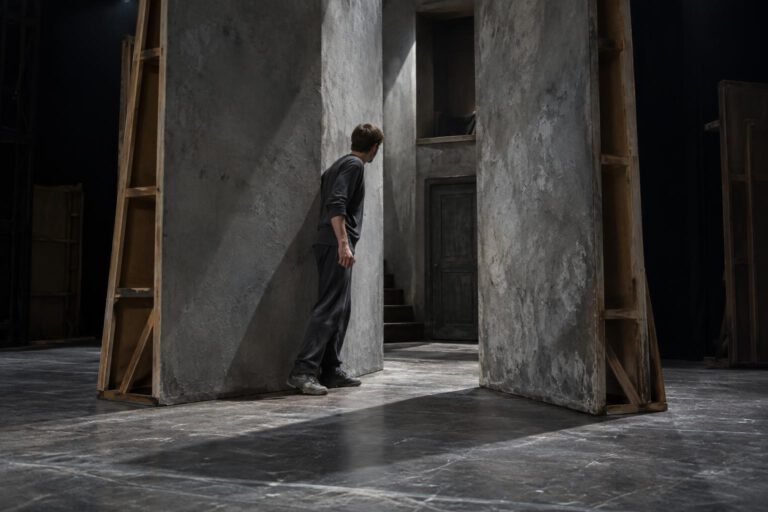
Karin Henkel directed the play at Vienna’s Burgtheater; the Austrian premiere on 9 May 2026 featured set design by Thilo Reuther, costumes by Teresa Vergho and music by Matthias Grübel. These details describe the particular production, not Palmetshofer’s text alone. The distinction matters: a production establishes its own emphases and creates its own images, while the play provides an open linguistic and dramatic structure. Henkel’s team brings Palmetshofer’s Shakespeare adaptation into a space where theatre, political threat and grotesque exaggeration are brought into relation with one another.
No stability without responsibility
The prize does not make Palmetshofer the proclaimer of a religious answer. More interesting is the tension his plays leave unresolved: what remains of responsibility when inherited order and metaphysical certainties fade? And how can a sense of community be upheld without pushing the more vulnerable to the margins? In “Sankt Falstaff”, this tension is sharpened politically; in earlier works, it also centres on family, social background and the desire to be seen.
The Ludwig-Mülheims-Theaterpreis’s recognition of his work thus reads less as an affirmation of a programme of faith than as an acknowledgement of a persistent search. Palmetshofer’s characters do not simply find something to hold on to. They show how much work it takes to maintain that foothold – and what responsibility towards others arises from it.
Original reviewed by the editors · 3 November 2026