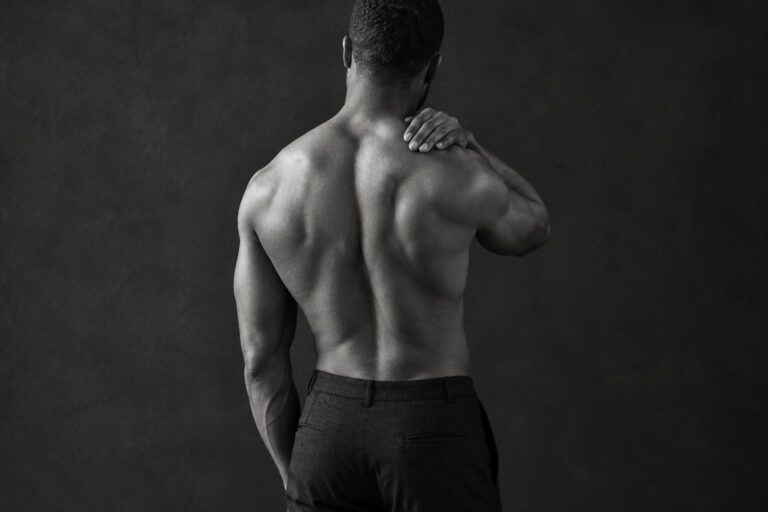
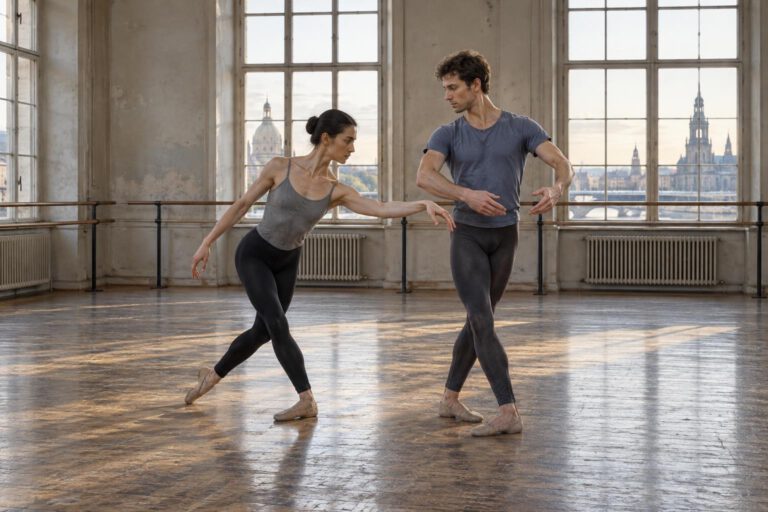
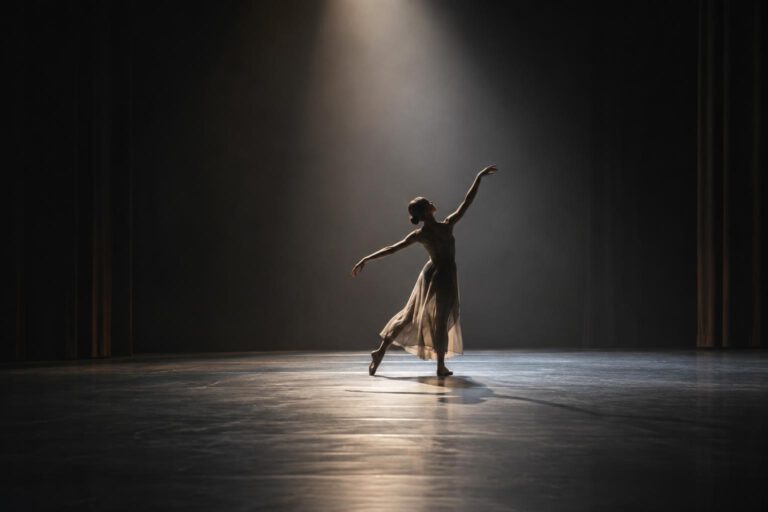
For twenty years, Doris Uhlich has been asking what a body is allowed to do in dance – and who decides. The Austrian choreographer starts not with an ideal form, but with people with different biographies, physical capabilities and experiences of movement. In her work, a gesture can be everyday, a ballet step can become a choreography of resistance, a dance floor more than a stage: a place that reveals which bodies are otherwise taken for granted.
From 5 November to 5 December 2026, the retrospective ‘BOOM TSCHAK: 20 Jahre Doris Uhlich’ (BOOM TSCHAK: 20 Years of Doris Uhlich) brings together works, films, discussions and workshops. The programme takes place across Tanzquartier Wien, brut Wien, Belvedere 21 and the Josephinum. It is more than a parade of past successes: five thematic strands – from early works through ballet and technology to nudity and slime as a material – aim to trace connections across her work.
Against the Clean Line
Born in Upper Austria in 1977, Uhlich studied contemporary dance education at the Konservatorium der Stadt Wien and began developing her own projects in 2006. From early on, her works unsettle the idea that dancing bodies must be slim, trained and flawless. In ‘mehr als genug’ (more than enough, 2009), society’s judgements about body size become an explicit subject. Later, ‘Every Body Electric’ (2018) opens the stage to performers with physical disabilities; ‘more than naked’ (2013) and other works explore nudity beyond a purely erotic or provocative reading.
This is not a simple message of inclusion repeated unchanged from piece to piece. Rather, Uhlich shifts the conditions of seeing: which movements count as virtuosic? Who is recognised as a dancer on stage? And what happens when, instead of the body following a predetermined form, the form takes its cue from the bodies? Choreography thus also becomes a social practice – without reducing the artistic work to an illustration of political arguments.
One Body of Work, Many Bodily Archives
In her biography, Uhlich describes the body as a ‘travelling bodily archive’: personal histories and social experiences leave their mark, but do not remain fixed. The image suits a practice that works with changing ensembles, different spaces and formats. ‘Habitat’, for instance, has appeared in various contexts since 2017; the series makes each location and the bodies gathered there part of the choreographic situation. ‘Ravemachine’ (2016), developed with the dancer Michael Turinsky, interweaves movement with club culture and the relationship between body and machine.
Such an archive cannot be recorded in its entirety. Video can make movements and earlier phases of work visible; a restaging, however, cannot bring back either the original moment or the original cast unchanged. What remains also includes methods, questions and relationships – and the knowledge of the people involved in the works. This is precisely why a retrospective is not neutral: it selects, organises and sets priorities. Whether it makes the participating performers as visible as the choreographer as bearers of this knowledge also depends on the specific design of the programme.
Looking Back without Standing Still
The announced ‘Early Works’ bring together, among others, ‘und’ (and) and ‘Impatiens walleriana’ (both 2007), as well as the film ‘sackl du printemps’ (2007). ‘World of Ballet’ focuses on Uhlich’s engagement with the forms of classical theatrical dance; ‘Welcome to the Machine’ on the relationship between people and technology. ‘Gootopian Times’ brings together works in which bodies interact with slime as a malleable material. The ‘Naked Works’ centre on questioning normative ways of looking and fixed roles.
This arrangement reveals how far Uhlich’s work extends beyond any single theme: from ballet codes to machines, from collective movement to small-scale encounters. At the same time, the question remains of how a retrospective can preserve the people and conditions behind these movements without turning them into mere archival material. For Uhlich, the body is not a store of data that can simply be read out. It keeps moving – and in doing so also changes what the past means.
Original reviewed by the editors · 3 November 2026