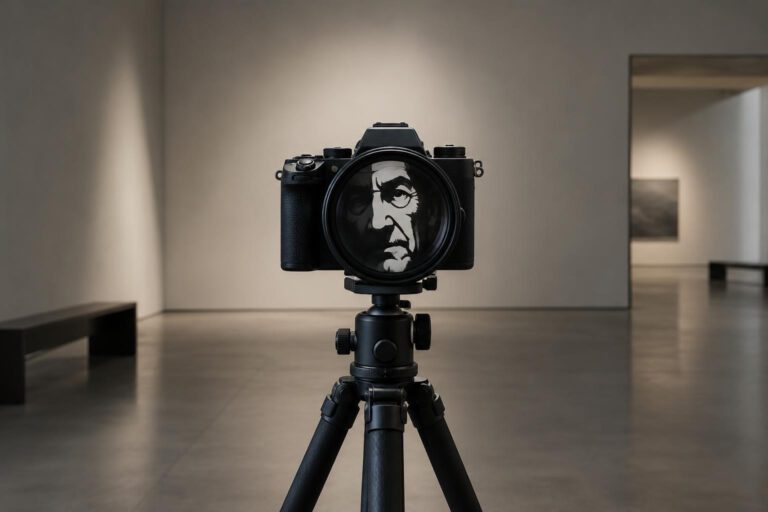
Crosshairs usually take aim at something. In radiotherapy, they mark a spot where treatment is to be targeted as precisely as possible. Herlinde Koelbl develops her new series, ‘Fadenkreuze für das Leben’ (Crosshairs for Life), from this shift between threat and medical precision. From 8 November, the Kunstmuseum Bonn will show portraits and conversations with 40 people who have been diagnosed with cancer.
The exhibition takes Koelbl’s own experience of cancer in 2019/20 as its starting point. According to the museum, the markings used in radiotherapy occupied her thoughts during treatment. They reminded the photographer of ‘Targets’, her earlier work with shooting targets and military crosshairs: a motif whose meaning changes fundamentally with a change of context. What is associated there with aiming and killing becomes, in therapy, a sign of precisely targeted treatment.
The portrait is not the whole person
Koelbl’s project brings together images and records of personal conversations. According to the museum, those portrayed speak about their experiences of illness; the exhibition includes people of different ages and backgrounds. Its focus is therefore not simply on a medical condition, but on stories that may encompass fear, hope and loss. Only the exhibition itself will reveal how far the conversations open up particular areas of people’s lives.
Yet a documentary portrait is never merely a neutral likeness. The photographer decides on distance, framing and timing. Whoever selects material from a conversation helps determine which statements appear alongside an image — and which do not. The information publicly available about the Bonn exhibition has so far offered no further explanation of how participants have a say in the selection, approval or subsequent use of photographs and conversation records. This is not to claim that they lack such opportunities. It is a question that inevitably arises in an exhibition about personal experiences of illness.
Self-determination does not, however, mean that a portrait can guarantee complete control over its impact. An image can be removed from the context of the exhibition, a statement shortened, or a person permanently associated with their diagnosis. The combination of photography and text makes the conditions of display particularly important: what story is being told, who is allowed to tell it, and does the person depicted remain more than their illness?
Between experience and public image
Koelbl is known for long-term projects such as ‘Spuren der Macht’ (Traces of Power), in which she uses photography to follow changes over an extended period. ‘Fadenkreuze für das Leben’ takes a different approach: its starting point is not public status, but an experience of illness and its visible traces. The photographer’s personal experience brings her close to the subject; it does not replace the individual perspectives of those portrayed.
The exhibition can therefore also be read as an invitation not to draw hasty conclusions about an entire life from individual images. Its medical motif carries a powerful shift in meaning, yet the stories behind it remain distinct. Whether the presentation preserves that individuality depends not only on what is shown, but also on how voice, image and context interact.
‘Fadenkreuze für das Leben’ is on view at the Kunstmuseum Bonn from 8 November 2026 to 16 May 2027. The opening begins at 11.30am on 8 November. The museum describes the exhibition as the first presentation of this series. Its subject is at once personal and public: making illness visible without defining the people it affects by that visibility.
Original reviewed by the editors · 28 October 2026