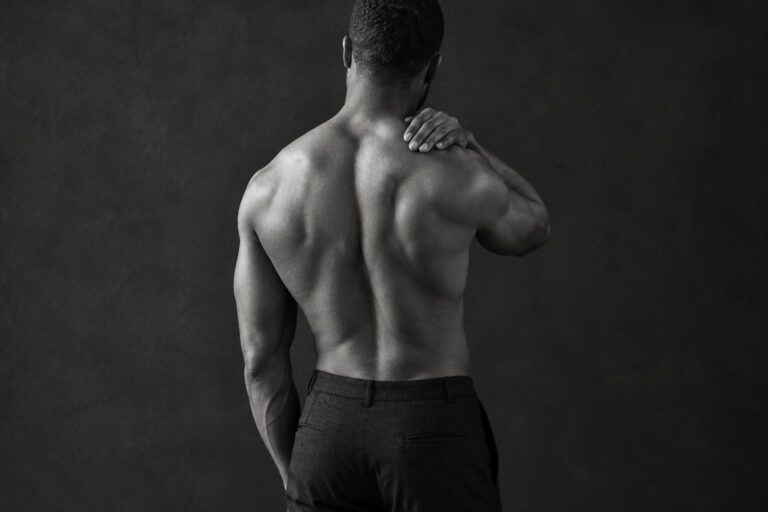
Fear is a feeling that operates on many scales: it can constrict the body, strain relationships or arise from political uncertainty. Vienna Art Week makes it the theme of its 22nd edition. Under the banner of “Navigating Angst”, the festival brings together exhibitions and events at various venues in Wien from 6 to 13 November 2026. Its main exhibition, the “House of Navigating Angst”, occupies a former tenement building on the Gürtel in the 15th district. Work by 30 artists is planned across four levels.
The question is not simply how fear can be represented. It is also what an exhibition does with it: does it sharpen our awareness of specific conditions, or turn unease into an atmosphere designed to draw an audience? Some of the works announced rely not on shocking images, but on materials, bodies and the contradictions of everyday experience.
The body as contested territory
Paulina Emilia Aumayr takes small impressions of her own body as her starting point. As the Austrian newspaper “Presse” reports in its preview, she makes casts of her navel and encases paintings of dogs within them in resin. In the paintings, the animals raise their legs as though marking territory. Aumayr connects this motif with the fear that women cannot take control over their own bodies for granted. The work does not illustrate a single scene of violence; it directs attention towards the conditions that make threats possible. This shifts the emphasis from horror as an image to questions of power and ownership.
Sophie Hirsch also works with a sense of bodily unease. She pours silicone onto plaster, works the material and wraps it in dyed fabric. According to the preview, these soft, sometimes fleshy-looking forms encounter chains or metal rods. Softness and hardness, support and instability remain present at the same time. Fear thus appears not as an unambiguous message, but as a tension that lodges in the body and can also set it in motion.
From private feeling to political circumstances
The fact that fear does not remain a private matter is also evident in the programme beyond the main exhibition. At WUK, a curatorial event guides visitors through “Off the Precipice”, a group exhibition by eleven artists exploring political and social upheaval. This is to be followed by a performance by Holden Madagame, combining movement, drumming and singing with Indigenous knowledge and connections to ancestors. WUK describes the performance as ritual-based; a detailed interpretation cannot be offered before it takes place.
The contrast with Hirsch’s material-based work is revealing: there, fear becomes tangible through a bodily surface; here, the question of collective life in times of upheaval comes to the fore. The two can coexist without one explaining the other. This is precisely where a challenge lies for the exhibition’s theme: political threats must not become mere backdrops for personal feelings; conversely, personal experience should not present itself as a universally applicable formula.
Not every fear needs a climax
Leslie de Melo offers another counterpoint. His series of drawings announced for WUK uses graphite on paper and considers hope as a counterweight to fear. This is more than a reassuring closing note. It broadens the question: not only what people fear, but how they can continue to act and remain connected to one another despite uncertainty.
Curators Robert Punkenhofer and Anne Zühlke bring together different artistic responses to this terrain in the “House of Navigating Angst”. Whether the exhibition can hold this diversity together will only become clear in situ. As a guiding idea, “Navigating” – finding a way through – is certainly more precise than a promise to dispel fear. Art can make it visible and open to discussion. Its task is not to exploit it for the next dramatic effect, but to keep our attention open to its causes and to possible scope for action.
Original reviewed by the editors · 3 November 2026