The first excavator to break ground at Kampnagel on 30 October marked both the start of construction and a stage set: an artistic intervention framed the symbolic groundbreaking ceremony. Behind it, a very tangible redevelopment is beginning. The listed Hamburg site is to be refurbished and extended at a cost of 168 million euros – while remaining operational. The crucial question is not just what will be built, but who will actually have space to work in the meantime.
Building on rather than replacing
Kampnagel was an ironworks and a machine factory, and for decades has been an international production house for the independent performing arts. Its halls embody that history as more than an industrial backdrop: their large, versatile spaces enable productions that cannot readily be transferred to a conventional theatre. The city has commissioned the Paris-based practice Lacaton & Vassal to design the scheme; the municipally owned Sprinkenhof GmbH is responsible for the project. Hamburg is contributing 108 million euros, the federal government 60 million.
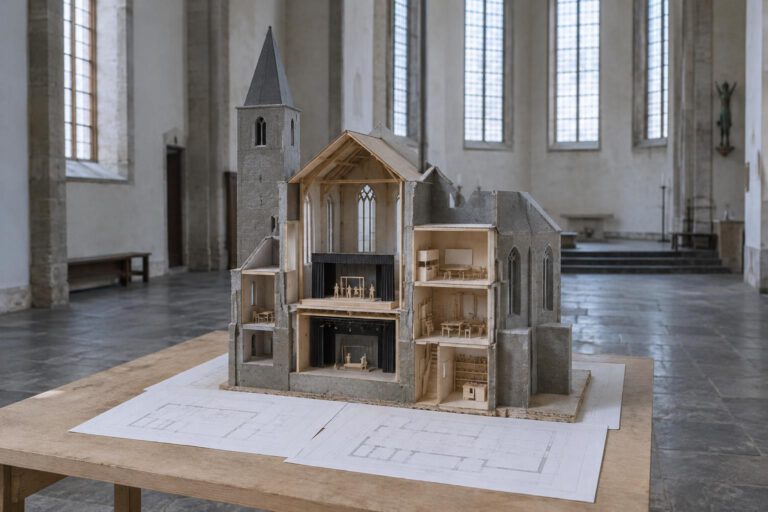
The guiding principle, “Keep. Repair. Add.”, describes an architecture of addition: existing buildings are to be retained and renewed, rather than replaced by an entirely new development. Two new buildings will extend the existing complex. K7 is planned above the foyers, with spaces for rehearsals, workshops and training; there will also be a residence building with 26 rooms for international artists. Six rooms are to be wheelchair-accessible. The halls and technical areas will also be refurbished, and the spaces are to become more flexible in use. These are tangible gains – but they will not arrive all at once, nor benefit every area of work equally.
The first construction phase comes at a price
According to Kampnagel’s redevelopment information, the southern section of the complex will largely remain a construction site during the first phase, from September 2026 until an anticipated spring 2028. Areas affected include halls k1, k2, k4 and kmh, as well as p1, the foyer, cinema and restaurant. For now, k6, kx and 6a will remain available. Operations will therefore not simply continue unchanged: smaller and medium-sized venues in particular will be missing, and projects will have to find other formats or performance spaces.
The disruption to rehearsals is even more pronounced. These are to move largely to Kaltenkircher Platz, to a former post office building with rooms of various sizes. Kampnagel’s information sheet also notes that options there are limited, that most rooms are not wheelchair-accessible, and that spaces – particularly accessible ones – will have to be shared. For independent productions, this is not merely a question of address. Rehearsal schedules, accessibility and technical conditions shape who can work and how a piece comes into being at all.
Staying open does not mean everything is available
The second construction phase is scheduled for summer 2028 to mid-2029. During this period, k6, the entrance hall and the administration areas, among others, will be redeveloped; at the same time, refurbished spaces and K7 are due to open. During the transition between phases, the redevelopment information states, no halls on the site will be available for performances. All halls are scheduled to return to use for the 2029/2030 season. Performances are to continue in an adapted form, including events in urban spaces and collaborations with other venues.
“While remaining operational” suggests continuity, but primarily describes an organisational challenge. The client must coordinate access, noise, safety and the construction schedule with the programme; the venue must relocate productions and reallocate spaces. Kampnagel’s intention to accompany the transformation artistically may generate public attention. But it is no substitute for suitable rehearsal spaces, nor does it yet answer how competing needs will be resolved.
The extension promises more space for production, accommodation and encounters. Whether these gains also reach those who depend on affordable, accessible working conditions with few physical barriers will not be decided by the completed building alone. It will be decided in the intervening years – through the allocation of scarce spaces and whether the production house can put its commitment to openness into practice even amid construction.
Original reviewed by the editors · 31 October 2026